
Russell leads Monza final practice as FIA hits back at Briatore's Monaco allegations
The Temple of Speed is living up to its billing this weekend, and not only because of what’s happening on the stopwatch. Monza has served up the low-drag, high-stakes theatre this circuit always promises, but the paddock’s attention has been split three ways today — between a compelling qualifying build-up, a smouldering governance row that refuses to go away, and a fresh reminder that F1’s newest team is still finding its feet under FIA scrutiny. Throw in a heat hazard declaration and a team boss taking a joyride in a 1990 Footwork Arrows, and it’s been a properly full Saturday even before a single flying lap counted for anything.
Russell sets the benchmark, but Monza rarely rewards Friday-Saturday form alone
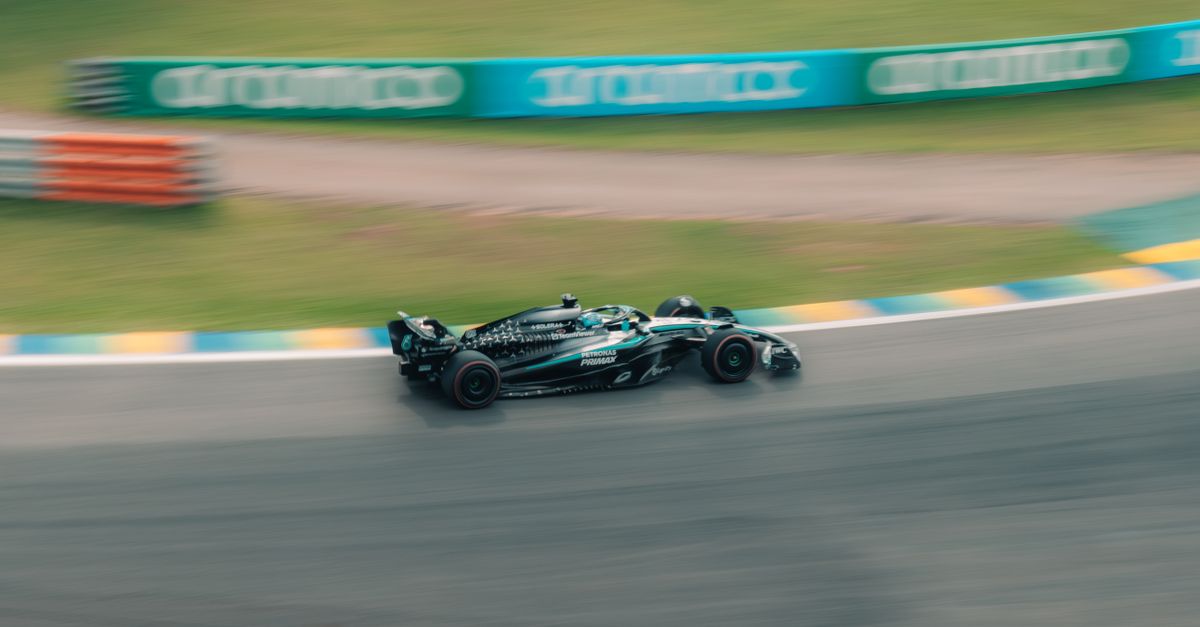
George Russell topped final practice ahead of Lewis Hamilton, with Max Verstappen also in the mix, and on a track as unforgiving of set-up compromise as Monza, that head start matters more than it might elsewhere. This is a circuit built almost entirely around minimising drag — the corners are largely incidental, punctuation marks between the straights — so the teams that get their aerodynamic trim level and engine mapping right in FP3 tend to be the ones genuinely fighting for pole rather than just looking competitive in isolation.
Russell’s pace is notable for a couple of reasons. Mercedes has traditionally been strong at low-downforce venues when their power unit and cooling package have been in good health, and a clean margin over Hamilton — who has generally been Ferrari’s benchmark through this Monza weekend and arrives with the added significance of representing the Scuderia at their home race — suggests Mercedes have found a genuinely quick window rather than a lucky one. Whether that translates directly into pole is another matter. Monza qualifying is as much about trim level and tow strategy as it is about outright car pace, and FP3 form has a habit of being reshuffled once slipstreaming battles are added to the equation in Q3.
The tow is the real story
Mercedes were explicit about practising the tow in FP3, and that’s worth dwelling on rather than treating as a footnote. At Monza, a well-timed slipstream can be worth several tenths — sometimes the difference between the front row and fourth on the grid — and teams have increasingly turned this into a coordinated exercise rather than a happy accident. What’s notable here is that Russell topped the session without needing the assistance himself, which tells you two things: first, that Mercedes’ underlying pace is strong enough to lead without a leg-up, and second, that they have a workable plan in hand for qualifying if timing allows a driver pairing to properly execute a tow run. Teams that get this wrong — mistimed exit from the pits, a queue forming at the Rettifilo, a driver unable to find a gap — can talk themselves out of pole through pure logistics. Mercedes look drilled on this front, and that discipline could be decisive this afternoon.
The Hamilton-Verstappen near-miss deserves more scrutiny than a footnote
Buried within the practice reports was a moment that could easily have derailed both Ferrari’s and Red Bull’s weekends: Hamilton and Verstappen came close to colliding at the chicane during FP3. At a circuit where cars are running at their lowest downforce levels of the season and braking zones are consequently longer and more variable, these situations crop up more often than fans might expect — but that doesn’t make them any less serious when two cars of this stature are involved.
It’s worth being measured here rather than reaching for melodrama. Free practice incidents involving cars on differing programmes — one on a push lap, another backing off or preparing for a tow — are an occupational hazard of low-downforce Monza, where sightlines through the chicanes are compromised and speed differentials can be enormous. No contact occurred, no stewards’ investigation followed, and both drivers will have logged the moment and moved on. But it’s exactly the kind of near-miss that tends to sharpen minds ahead of qualifying, where identical circumstances — mixed-speed traffic, drivers hunting a tow, blind exits from the chicane — will be repeated at even higher stakes. Expect both camps to have had pointed conversations about track awareness before this afternoon’s session.
Briatore’s Monaco allegations and the FIA’s response
The more combustible story of the weekend, though, has nothing to do with lap times. Flavio Briatore’s allegations on Friday, relating to the amended result from the Monaco Grand Prix, prompted a strongly worded rebuttal from the FIA — and that in itself tells you how seriously the governing body is treating the implication behind his comments. When a team principal of Briatore’s standing and history publicly questions the integrity of a race result change, the FIA cannot simply let it pass; silence would be read as evasiveness regardless of the substance of the claim.
This matters beyond the immediate news cycle for a few reasons:
- Precedent and credibility. Post-race result changes are rare enough that when they happen, they invite scrutiny of process — who reviewed what, on what evidence, and why a decision was revisited rather than settled on the day. A public accusation of irregularity, even if ultimately unfounded, forces the FIA to be more transparent about its internal processes than it might otherwise choose to be.
- Briatore’s history with governance disputes. Given his own past entanglements with the FIA, his willingness to go public rather than pursue this through private channels is itself telling — either he judged private channels to have already failed him, or he’s calculating that public pressure is the more effective route to a review.
- The wider trust question. F1’s stewarding and post-race adjudication processes have faced years of criticism for perceived inconsistency. Every high-profile allegation of this kind, whether it holds up or not, chips away at broader confidence in the sport’s officiating unless it’s addressed head-on and clearly.
GP Headlines’ view: the FIA was right to respond firmly and quickly rather than let the allegation sit unanswered over a race weekend, but a statement alone won’t close this out. If Briatore’s claims have any substantive basis, the governing body needs to show its working — literally publish the reasoning behind the Monaco result change — because in the current climate, “trust us” is not a sufficient answer to a direct challenge from a team principal. Conversely, if the allegations are baseless, the FIA would do well to say so explicitly rather than leaving the matter in the ambiguous space of a “strongly worded statement” that neither confirms nor denies the specifics.
Cadillac’s early lessons in scrutiny
Elsewhere, the FIA confirmed Cadillac’s punishment following the investigation into Colton Herta, closing out a story that’s been simmering through the weekend. The specifics of the sanction matter less, for the purposes of a season-long narrative, than what it represents: a new team on the grid is already learning, in real time, how unforgiving the FIA’s compliance environment can be.
Every entrant that has joined the grid in the last two decades — from the backmarker collapses of the early 2010s to more recent additions — has gone through a period where every marginal call, every grey-area interpretation of the rules, gets picked apart more forensically than it would for an established outfit with a longer track record of good faith. That’s not necessarily unfair; it’s simply the reality of being the newest name in the paddock, without the accumulated credit that comes from years of clean compliance. How Cadillac responds to this — whether through public frustration or quiet process correction — will say a good deal about the team’s internal culture as it tries to establish itself as a serious, sustainable outfit rather than a project defined by its early growing pains.
Heat hazard declared: a race of management as much as speed
The FIA’s heat hazard declaration for the Italian Grand Prix is not a formality. Under the sport’s heat hazard protocols, teams and drivers are given advance notice specifically so they can prepare — cooling vests, hydration strategy, and in some cases modified car cooling configurations — and its invocation at Monza tells you this weekend’s conditions are expected to push cars and drivers close to their thermal limits.
This has genuine sporting consequence. Monza’s long full-throttle sections generate less airflow-driven cooling relative to the engine and battery loads involved than a circuit with more sustained high-speed cornering, and teams often run a delicate balance between opening bodywork for cooling — which costs outright pace through added drag — and keeping the car as slippery as possible for a circuit built on minimising exactly that. A hot race adds tyre degradation questions too, particularly given Monza’s abrasive surface and the physical toll on drivers over a race distance in high cockpit temperatures. Don’t be surprised if strategy calls on Sunday are shaped as much by managing car and driver temperatures as by the usual tyre-life calculations.
A lighter note from the paddock
Amid the tension, Haas team principal Ayao Komatsu’s outing in a 1990 Footwork Arrows A11B was a welcome reminder of what draws people to this sport in the first place. Monza’s history runs deep, and a modern team boss getting behind the wheel of a Cosworth-powered relic from over three decades ago is the sort of story that humanises a paddock often consumed by regulatory disputes and championship permutations. It’s a small thing, but it’s exactly the kind of heritage moment this circuit does better than almost anywhere else on the calendar.
On the radar
- Qualifying fallout — how the tow strategies actually play out in Q3, and whether Mercedes’ FP3 pace converts into pole position.
- Any further FIA disclosure on the Monaco result-change process, given the pressure created by Briatore’s allegations.
- Cadillac’s next steps — whether the Herta punishment prompts any operational or personnel response from the team.
- Race-day heat management — tyre degradation and driver cooling strategies once the heat hazard conditions are in full effect on Sunday.
- Verstappen and Hamilton’s wheel-to-wheel form — after Saturday’s near-miss, whether that close-quarters intensity carries into the race itself.
- Ferrari’s home-race pressure — whether Hamilton’s practice pace can be sharpened further with a passionate Monza crowd willing them on.
Monza has a way of compressing a season’s tensions into one high-speed weekend, and this one has delivered on that promise before qualifying has even started. The lap times will settle the sporting argument this afternoon; the governance argument around Monaco looks set to run a good deal longer.